
For further information on the collection objects in this section, please click on the links below the images.
1818
- The keyed flute harmonique, although nothing is known about this instrument.
1821
- The Acoucryptophone, or enchanted lyre. It was a lyre suspended from a ceiling by a brass wire, appearing to play by itself, but was acting as a sound conductor and amplifier to instruments being played in the room above.
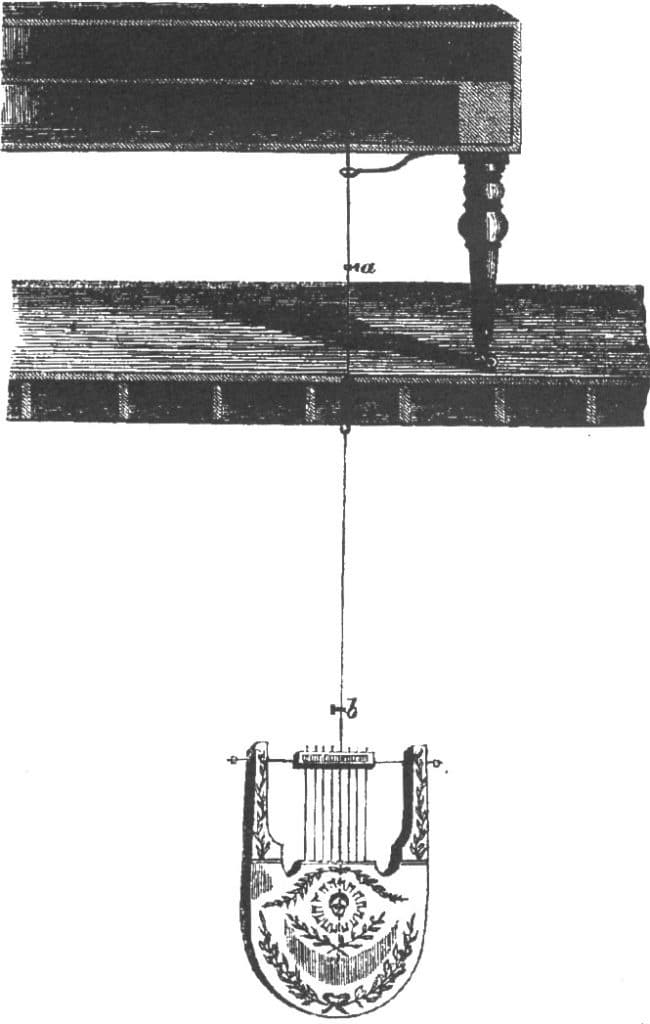
1822
- The Diaphonicon, a horizontal sound conductor for both music and voice, which ran between two rooms.
1823
- ‘New Experiments in Sound‘, Thomson’s Annals of Philosophy, 1823, Vol. vi, p. 81-90.
- ‘Experiments relating to the Passage of Sound through Rectiliniar and Bent Conductors‘ letter read by Arago, Academy of Sciences, France, June 30th 1823.
- A letter by Sophie Germain concerning ‘the experiments of Vibrations on Metallic Plates‘ by M. Wheatstone’ read at the Academy of Sciences, France, 1st September 1823.
1824
- An Explanation of the Harmonic Diagram, invented by C. Wheatstone, London (London: C. Wheatstone, 436 Strand, 1824).
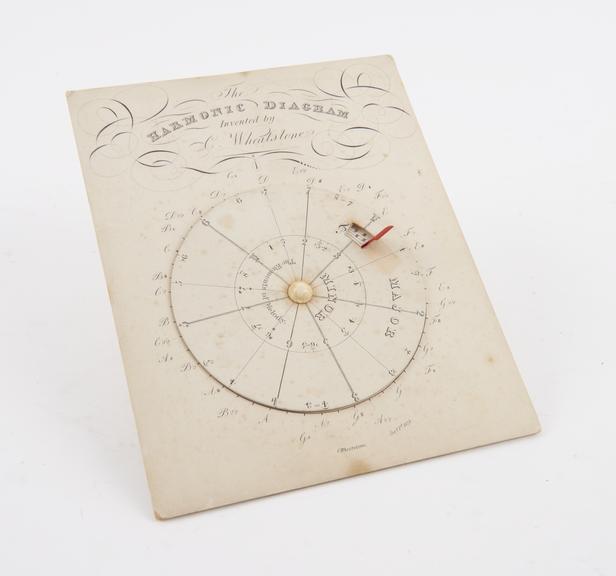
Wheatstone’s harmonic diagram. Science Museum Group. Cat. No. 1972-426.
1826
- The kaleidophone, a metal rod with a bead attached. When the rod is struck, the vibrations carry the bead along giving a visual perception of the movement of sound.
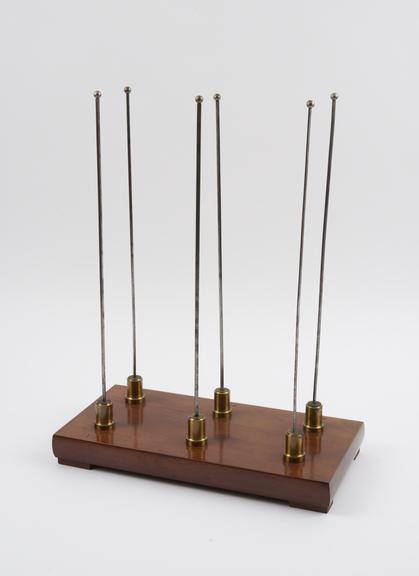
Wheatstone’s Kaleidophone. Science Museum Group. Cat. No. 1988-674.
1827
- Description of the kaleidophone or phonic kaleidoscope: a new philosophical toy, for the illustration of several interesting and amusing acoustical and optical phenomena’, Quarterly Journal of Science, Literature, and Art, 1827, Vol. i; and patented his invention.
- ‘Experiments on Audition‘, Quarterly Journal of Science, Literature, and Art, 1827, Vol. ii.
1828
- ‘On the Resonances, or Reciprocated Vibrations of Columns of Air‘, Quarterly Journal of Science, Literature, and Art, 1828, Vol. iii, p.175-83.
- Created a Terpsiphone, an experimental musical instrument that aimed to reproduce sound using columns of air in a toroid shape.
1829
- The Symphonium, a mouth organ with keys.
- The Concertina, a free-read musical instrument, similar to the accordian, but hexagonal-shaped with keys at both of end of the instrument, operating parallel to the bellows’ travel.
- June 19th: Patent 5803 ‘A certain improvement or certain improvements in the construction of wind musical instruments.’

Symphonium. The Metropolitan Museum of Art. Cat. No. 89.4.2085.
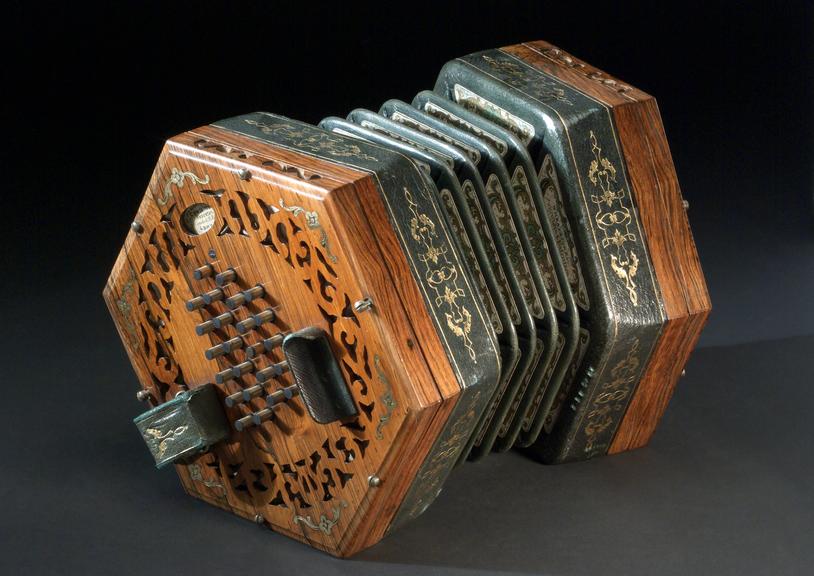
Wheatstone concertina. Science Museum Group. Cat. No. 1857-29.
1831
- ‘Transmisson of Sounds through Solid Linear Conductors, and on their Subsequent Reciprocation‘, Journal of the Royal Institution, 1831, Vol. ii.
1832
- The reflecting and refracting Stereoscopes, but does not present them to the world yet.
- ‘On the Vibrations of Columns of Air in Cylindrical and Conical Tubes‘ given to the Royal Institution, Athenaeum, March 24 1832, p.194.
- ‘Some Remarks on Dreaming, Somnambulism and other States of Partial Activity in the Cerebral Faculties‘ read to the London Phrenological Society, Jan. 1832.
1833
- ‘On the Figures Obtained by Strewing Sand on Vibrating Surfaces, Commonly Called Acoustic Figures‘, Philosophical Transactions of the Royal Society, 1833, pp.593-634.
1834
- ‘An Account of some Experiments to Measure the Velocity of Electricity and the Duration of Electric Light‘, Philosophical Transactions of the Royal Society, 1834, p.583-591.
1835
- Gave a lecture at the Royal Institution on Speaking Machines; devices capable of reproducing the human voice. Wheatstone built a speaking machine, which he kept at King’s College, London.
- ‘An Account of Some Experiments the Velocity of Electricity and the Duration of Electric Light‘, read at the Academy of Sciences, France, 12th January 1835.
- ‘Experimental Verification of Bernouilli’s Theory of Wind Instruments‘, ‘Remarks on Purkinje’s Experiments‘, ‘On the Prismatic Decomposition of Electric Light‘ and ‘Imitation of Human Speech by Mechanism‘, Report of the British Association, 1835, p.11-12, 14, 551-553, 558.
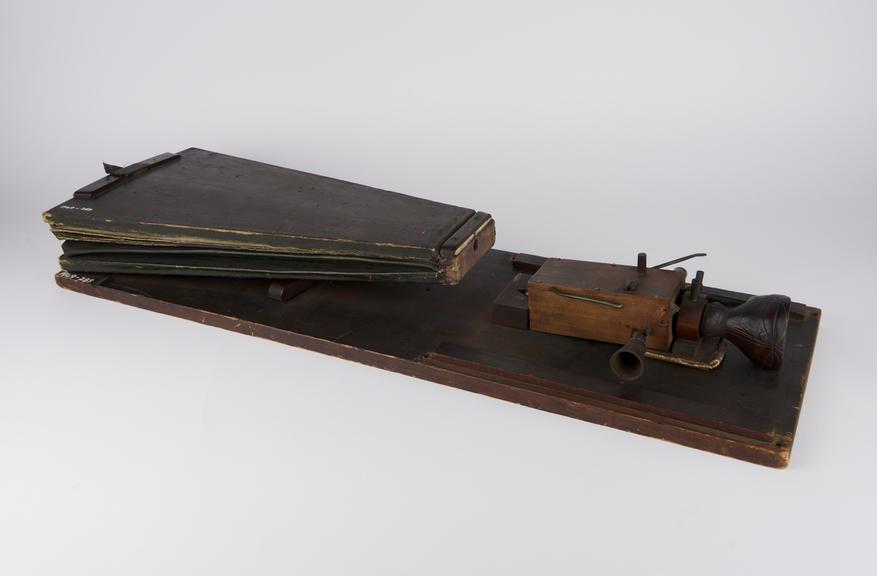
Wheatstone’s artificial voice-box. Science Museum Group. Cat. No. 1949-289.
1836
- July 27th: Patent 7154, with John Green, ‘A new method or methods of forming musical instruments in which continuous sounds are produced from strings, wires, or springs.’
1837
- The Five-needle telegraph (also the electric telegraph), one of the earliest practical designs of the telegraph, patented with William Fothergill Cooke.
- June 12th, Patent 7390: Cooke, W F, and Wheatstone, ‘Improvements in giving signals and sounding alarums in distant places by means of electric currents transmitted through metallic circuits’.
- Researches and develops submarine telegraphy.
- ‘On the Thermo-Electric Spark‘, Philosophical Magazine, 1837, Vol. X, p.414-417.
- [A chapter looking at the various attempts which have been made to imitate the articulations of speech by mechanical means.] London and Westminster Review, 1837, Vol. 28, p.27-41.
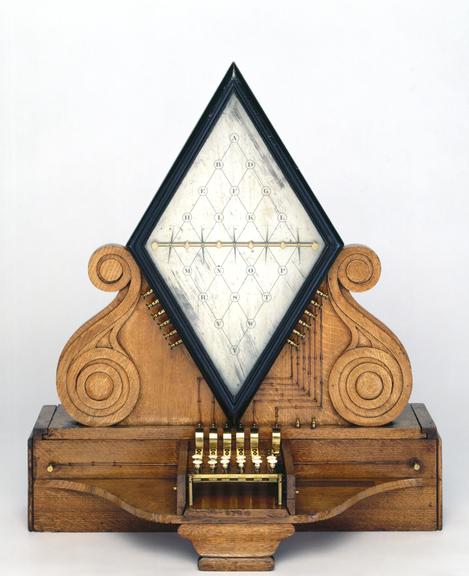
Cooke and Wheatstone Five Needle Telegraph. Science Museum Group. Cat. No. 1876-1272

Section of First Telegraph Cable 1837. Science Museum Group. Cat. No. 1867-37.
1838
- Presented the mirror stereoscope and theory of binocular vision to the Royal Society, using how each eye sees a slightly perspective of the world, the brain fuses the two, and one 3-D image is formed.
- ‘Contributions to the Physiology of Vision. — Part the First. On Some Remarkable, and Hitherto Unobserved, Phenomena of Binocular Vision‘, Philosophical Transactions of the Royal Society, 1838, p.371-394.

Wheatstone’s original reflecting stereoscope. King’s College London Archives. Cat. No. K/PP107/11/4/1. Photographed with kind permission.
1840
- The cell or battery and early magneto-induction devices.
- The ABC telegraph.
- Introduced the Chronoscope, a device used for measuring very short time intervals, which was later improved and more widely used as the “Hipp chronoscope”.
- Jan. 21st, Patent 8345: Wheatstone, C and Cooke, W F, ‘Improvements in giving signals and sounding alarms in distant places by means of electric currents transmitted through metallic circuits‘.
- ‘Account of an Electro-magnetic Telegraph‘, Annals of Electricity, Vol. 5, 1840, p.337-349.
- ‘Description of the Electro-magnetic Clock‘, Proceedings of the Royal Society, 1840, Vol. iv, p249-250.
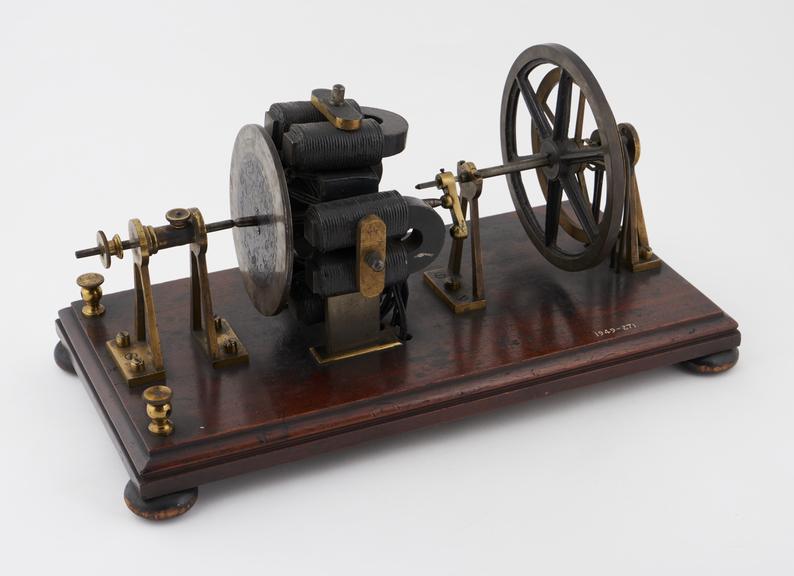
A Wheatstone Electromagnetic engine. Science Museum Group. Cat. No. 1949-271/3.
Wheatstone ABC Telegraph Receiver. National Museum of American History. Cat. No. 1990.0539.17.
Wheatstone Slave Magnetic Clock. National Museum of American History. Cat. No. 1990.0539.37.
1841
- July 7th, Patent 9022: ‘Improvements in producing, regulating and applying electric currents.’
1842
- ‘Letter to Col. Sabine on a New Meterological Instrument‘ Report of the British Association for the Advancement of Science, 1842, pt.2, p9.
1843
- The Wheatstone Bridge, invented by Samuel Hunter Christie in 1833, but popularized and improved by Wheatstone in 1843. A precise electrical circuit used to measure unknown resistances.
- Annual Bakerian Lecture to the Royal Society, ‘An Account of Several New Instruments and Processes for Determining the Constants of a Voltaic Circuit.’
- ‘An Account of Several New Instruments and Processes for Determining the Constants of a Voltaic Circuit‘, Philosophical Transactions of the Royal Society, 1843, p.303-327.
- ‘Description of the Telegraph Thermometer‘, Report of the British Association, 1843, p128-129.

Wheatstone’s Original Bridge. Science Museum Group. Cat. No. 1949-292.
1844
- ‘On the Singular Effect of the Juxtaposition of Certain Colours Under Particular Circumstances‘, Report of the British Assocation for the Advancement of Science, 1844, p.10.
- ‘Enregistreur électromagnétique pour les Observations Météorologiques‘, Archives de l’Électricité, par A. de la Rive, 1844, t.iv, p.170-172.
- Feb. 8th, Patent 10041: ‘Improvements on the concertina and other musical instruments in which sounds are produced by the action of wind on vibratory strings.’
1845
- ‘Note sur le Chronoscope électromagnétique‘, Comptes Rendus de l’Académie des Sciences, 1845, tome xx, p.1554-1561.
- May 6th, Patent 10655: Charles Wheatstone and William Fothergill Cooke: ‘Improvements in electric telegraphs and in apparatus relating thereto; part of which improvements are applicable to other purposes.’
1848
- ‘On a means of determining the apparent Solar Time by the Diurnal Changes of the Plane of Polarization at the North Pole of the Sky‘, Report of the British Association, 1848, p.10-12.

c.1849
- Invented the wave machine to visualise the unseeable wave nature of light, providing an insight into the theoretical concepts of wave motion.
Wheatstone Wave Machine, c. 1875, Physics Dept., Union College, NY. maker: Rudolph Koenig.
1852
- ‘Contributions to the Physiology of Vision.— Part the Second. On Some Remarkable, and Hitherto Unobserved, Phenomena of Binocular Vision (Continued)‘, Philosophical Transactions of the Royal Society, 1852, Vol. 142, p.1-17.

Wheatstone Lenticular and Prismatic Stereoscopes (in centre). King’s College London Archives Collection, held previously in the Science Museum stores at Blythe House, London. Accessed and photographed with very kind permission from Adrian Whicher, Science Museum, and Dr. Geoffrey Browell, King’s College London Archives.
1853
- ‘On the Binocular Microscope, and on Stereoscopic Pictures of Microscopic Objects‘, Transactions of the Microscopical Society of London, 1853, p.99-102. Read by Dr. Lankester F.R.S., April 27, 1853.
1854
- Invented the Playfair Cipher, a manual symmetric encryption technique and was the first literal digram substitution cipher.
- ‘Note relating to M. Foucault’s new mechanical proof of the rotation of the Earth‘, Philosophical Transactions of the Royal Society, 1854, Vol. 6, p.65-68 [Read May 15 1851].
1855
- ‘An account of some experiments made with the submarine cable of the Mediterranean Electric Telegraph‘ Journal of the Franklin Institute, 1855, Vol. 60, Issue 6, p.397-400.
- A reply to Mr. Cooke’s pamphlet, ‘The Electric Telegraph; was it invented by professor Wheatstone? (London: Taylor and Francis, 1855).
1856
- ‘On Fessel’s Gyroscope‘, Proceedings of the Royal Society of London, 1856, Vol. vii, p.43-48. [Written 1854]
- ‘On the Formation of Powers from Arithmetical Progressions‘, Proceedings of the Royal Society of London, 1856, Vol. vii, p.145-151. [Written 1855]
- ‘An Account of some Experiments made with the Submarine Cable of the Mediterranean Electric Telegraph‘, Proceedings of the Royal Society, 1856, Vol. vii, p.328-333.
- ‘Note on the Position of Aluminium in the Voltaic Series‘, Proceedings of the Royal Society, 1856, Vol. vii, p.369-370.
Compound Gyroscope on Stand. National Museum of American History. Cat. No. 336580.
1858
- The automatic high speed telegraph.
- June 2nd, Patent 1239/1858: ‘Electric telegraphs, and apparatus connected therewith.’
- June 2nd, Patent 1241/1858: ‘Improvements in electro-magnetic telegraphs and apparatus used for transmitting signs or indications to distant places by means of electricity’.

Wheatstone automatic tape transmitter. Science Museum Group. Cat. No. 1964-83.
1859
- ‘Télégraphe automatique écrivant‘, Comptes Rendus de l’Académie des Sciences, 1859, tome xlviii, p.214-220.
1860
- Oct. 10th, Patent 2462/1860: ‘Improvements in electro-magnetic telegraphs and apparatus for transmitting signs or indications to distant places by means of electricity, and in the means of and apparatus for establishing electric telegraphic communication between distant places.’
1861
- ‘On the Circumstances which Influence the Inductive Discharges of Submarine Telegraphic Cables‘, Report on the Joint Committee appointed by the Lords of the Committee of Privy Council for Trade and the Atlantic Telegraph Company, to inquire into the Construction of Submarine Telegraph Cables (London: Eyre & Spottiswoods, 1861).
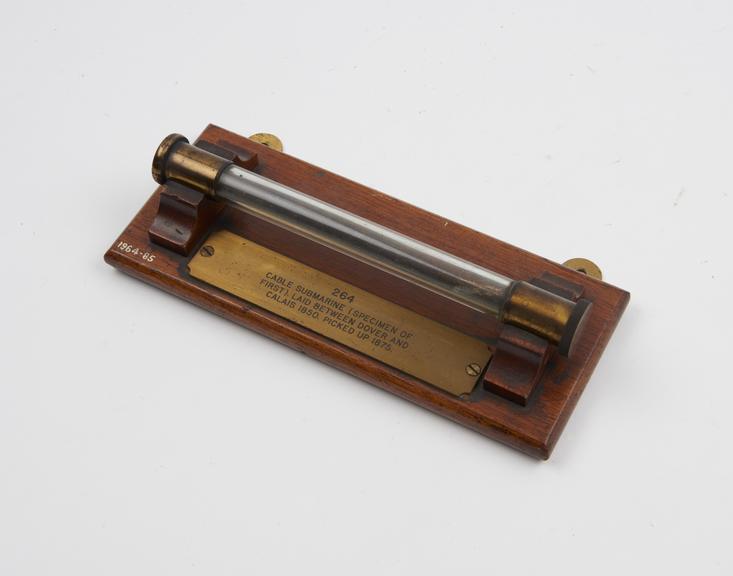
Specimen of 1850 submarine telegraph cable. Science Museum Group. Cat. No. 1964-85.
1862
- ‘Interpretation of an important Historical Document in Cipher‘ Memoirs of the Philobiblon Society, 1862, Vol. 7.
1867
- ‘On a New Telegraphic Thermometer, and on the Application of the Principle of its Construction to other Meteorological Indicators‘, Report of the British Association, 1867, p11-13.
- ‘On the Augmentation of the Power of a Magnet by the Reaction thereon of Currents induced by the Magnet itself‘, Proceedings of the Royal Society, 1867, Vol. xv, p.369-372.
- Oct. 10th, Patent 220/1867: ‘Improvements in electric telegraphs, and in apparatus connected therewith.’
1870
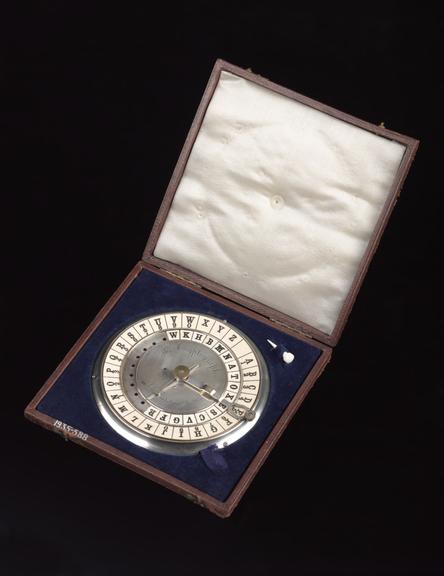
- c.1870, invented the Wheatstone Cryptograph.
- ‘On a cause of Error in Electroscopic Experiments‘ Proceedings of the Royal Society, 1870, Vol. xviii, p.330-333.
- Instructions for the Employment of Wheatstone’s Cryptograph [No date given, pamphlet accompanying the instrument].
- Nov. 3rd, Patent 2897/1870 with J.M.A. Stroh: ‘Improvements in fast-speed electro-magnetic telegraph, and in apparatus relating thereto.’
1871
- ‘Experiments on the Successive Polarization of Light, with the Description of a new Polarizing Apparatus‘, Proceedings of the Royal Society, 1871, Vol. xix, p.381-389.
- Aug. 18th, Patent 2172/1871 with J.M.A. Stroh: ‘Improvements in electro-magnetic telegraph apparatus‘.
1872
- Jan. 4th, Patent, 39/1872 with J.M.A. Stroh: ‘Improvements in musical instruments, in which vibrating tongues acted upon by air are employed‘.
- Feb. 15th, Patent, 473/1872 with J.M.A. Stroh: ‘Improvements in electro-magnetic telegraphs, and in apparatus conntected therewith, parts of which improvements are applicable to other purposes‘.
1875
- Aug. 5th, Patent 2771/1875: ‘Electric telegraphy‘. [Patent granted to R. Sabine, executor of Sir Charles Wheatstone].
 CharlesWheatstone.com